
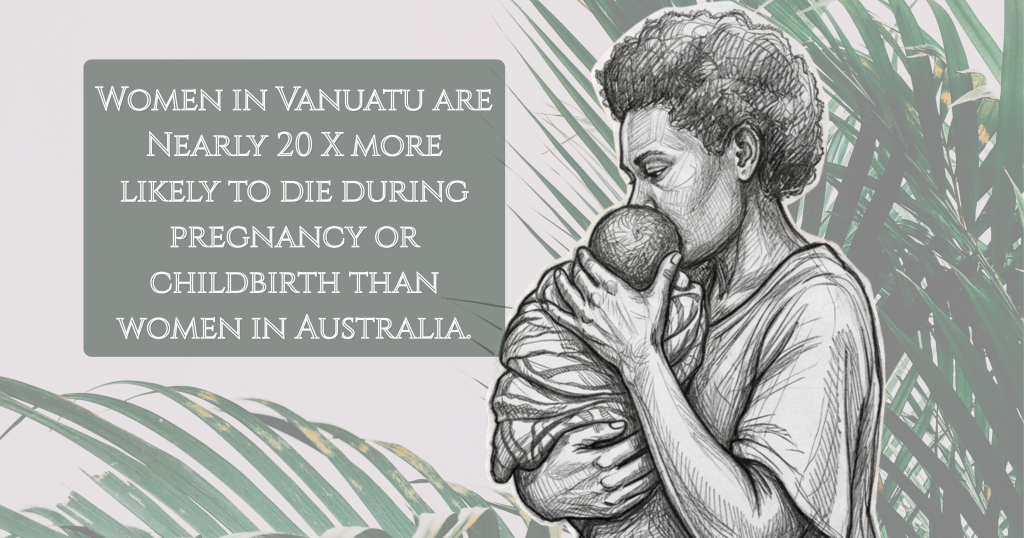
Vanuatu’s maternal mortality rate is around 94 per 100,000 births. Australia’s is 6. Behind those numbers are women, children, families and a gap that is not inevitable.
For most women in Australia, giving birth happens in a hospital surrounded by trained doctors, midwives, and modern medical equipment — or at home, attended by a midwife of their choosing.
For many women in Vanuatu, childbirth can look very different. And as colonisation continues to impact, the traditional knowledge held by older women is being lost.
So, if there is problem in labour, it may mean travelling hours by boat or ute to reach the nearest clinic. Sometimes there is no doctor available. In some communities, there is only a small health post staffed by a single nurse who may have little to no training that could make a difference — or no facility at all. When complications arise, help is rarely easy, close or affordable.
The result is a stark and troubling gap: women in Vanuatu are around 20 times more likely to die during pregnancy or childbirth than women in Australia.
A Gap Measured in Lives
Maternal mortality — the death of a woman during pregnancy, childbirth, or within 42 days of birth — is one of the clearest indicators of inequality in global health systems.
According to the Healthy Newborn Network, Vanuatu’s maternal mortality ratio sits at approximately 94 deaths per 100,000 live births. In Australia, the figure is 8.2 deaths per 100,000, according to the Australian Institute of Health and Welfare’s most recent data.
Behind these numbers are women, their children, their families and their communities. And many of these deaths are preventable.
The loss of a mother permanently disadvantages the children she leaves behind — economically, emotionally, and in their own long-term health outcomes. Globally, the WHO estimates that approximately 92% of maternal deaths occur in low and lower-middle income countries, most of which could have been prevented with access to basic care.
Geography Is Part of the Problem
Vanuatu is an archipelago of 83 islands scattered across the South Pacific, 65 of them inhabited. Many communities are remote and difficult to reach.
For pregnant women on outer islands, accessing care may require hours — sometimes days — of travel by boat or small plane. Bad weather can delay transport. Fuel may not be available. Clinics may lack equipment or trained staff. Families may not have money for transport costs.
These realities create life-threatening barriers at the moment women need support most.
Cyclones compound everything. Vanuatu’s vulnerability to natural disasters creates additional risks for maternal health — Cyclone Pam in 2015 alone damaged approximately 40% of health facilities across the country.
When Basic Infrastructure Is Missing
Distance is not the only challenge.
It starts at the basic infrastructure – systems most Australians take for granted and they’re what also shapes who lives and who dies in childbirth. Access to clean water, reliable power, functioning roads and equipped health facilities all directly influence maternal health outcomes.
Mary Jack, founder of Mitingar Women and Girls Association, has spent over 40 years advocating for improved living conditions for women across Vanuatu’s islands. She describes the reality plainly…
“As women, we don’t have running water. There is no running water. We don’t have lights. We do not have good feeder roads around us.”
Without reliable infrastructure, even reaching a clinic during labour can become a life-threatening journey.
The Knowledge That Colonisation Disrupted
There is another layer to this story that rarely appears in international health reports.
Before the disruption of colonisation, communities across Vanuatu held deep traditional knowledge about pregnancy, birth and recovery. Older women carried expertise in traditional medicines and birth practices, passed down across generations.
That knowledge has been actively eroded. Western health staff have discouraged the use of traditional medicine in and around clinics, and the intergenerational transmission of this knowledge has been interrupted in many communities. Women near health facilities have lost access to traditional support — without always gaining adequate access to formal care in its place.
Rebuilding and respecting that knowledge base — alongside, not instead of, improving formal health services — is part of what genuine, community-led maternal health looks like.
Midwives and Skilled Attendance
One of the most effective interventions for reducing maternal deaths globally is ensuring births are attended by skilled health workers.
Vanuatu has made progress — approximately 89% of births are now attended by skilled health personnel. But access varies dramatically across the 83 islands, and the country faces critical healthcare workforce limitations, with few specialists available outside the main islands.
Strengthening maternal health in island nations requires investment not only in hospitals, but in community health workers, rural clinics, transport systems — and in the recognition of traditional knowledge that has sustained communities for generations.
Why This Matters Beyond Vanuatu
Maternal health is not only a medical issue.
It reflects the strength of a country’s infrastructure, its healthcare systems, and how much it values the lives of women. When a woman dies in childbirth, the consequences ripple through families and communities. Children lose mothers. Partners lose spouses. Communities lose leaders and caregivers.
Reducing maternal mortality is one of the United Nations Sustainable Development Goals, which aims to bring global maternal deaths below 70 per 100,000 births by 2030. Achieving that goal requires confronting the inequalities — geographic, economic, colonial — that make childbirth far more dangerous for some women than others.
Women Are Already Leading the Way
Across Vanuatu, women are not waiting for solutions to arrive from outside.
They are organising networks, advocating for better infrastructure, and supporting one another through pregnancy, childbirth and recovery. They are fighting to have traditional knowledge respected alongside formal healthcare. And they are demanding to be heard in the national and international policy spaces where decisions about their lives are made.
Through Mitingar, NiVan women are building connections across the islands — strengthening community support systems and ensuring that the women most affected by these inequalities are the ones leading the solutions.
Mary’s vision is simple and non-negotiable.
“Women should not have to risk their lives to give birth. Access to safe childbirth, clean water, power and basic healthcare should not depend on where a woman lives.“
These are not luxuries. They are rights. And for the women of Vanuatu, they are long overdue.
Support the work of NiVan women.
Mitingar is Vanuatu’s national grassroots women’s organisation. Our Sister Circles operate as community disaster preparedness committees across the islands — building the local capacity that keeps communities standing after every storm.
- Sources
- WHO Maternal Health — who.int/health-topics/maternal-health
- Australian Institute of Health and Welfare, Maternal Deaths Australia — aihw.gov.au
- Healthy Newborn Network, Vanuatu Country Profile
- UNFPA Maternal Health — unfpa.org/maternal-health
- World Bank, Vanuatu Country Overview — worldbank.org
- UN Sustainable Development Goals, Goal 3 — sdgs.un.org/goals/goal3
- WHO Policy Survey 2018, Vanuatu Country Profile
